Noise Aversion in Cats: Not Just a Personality Quirk
Why fireworks, storms, and slamming doors can be more than "just a loud noise" for your cat, and what actually helps.
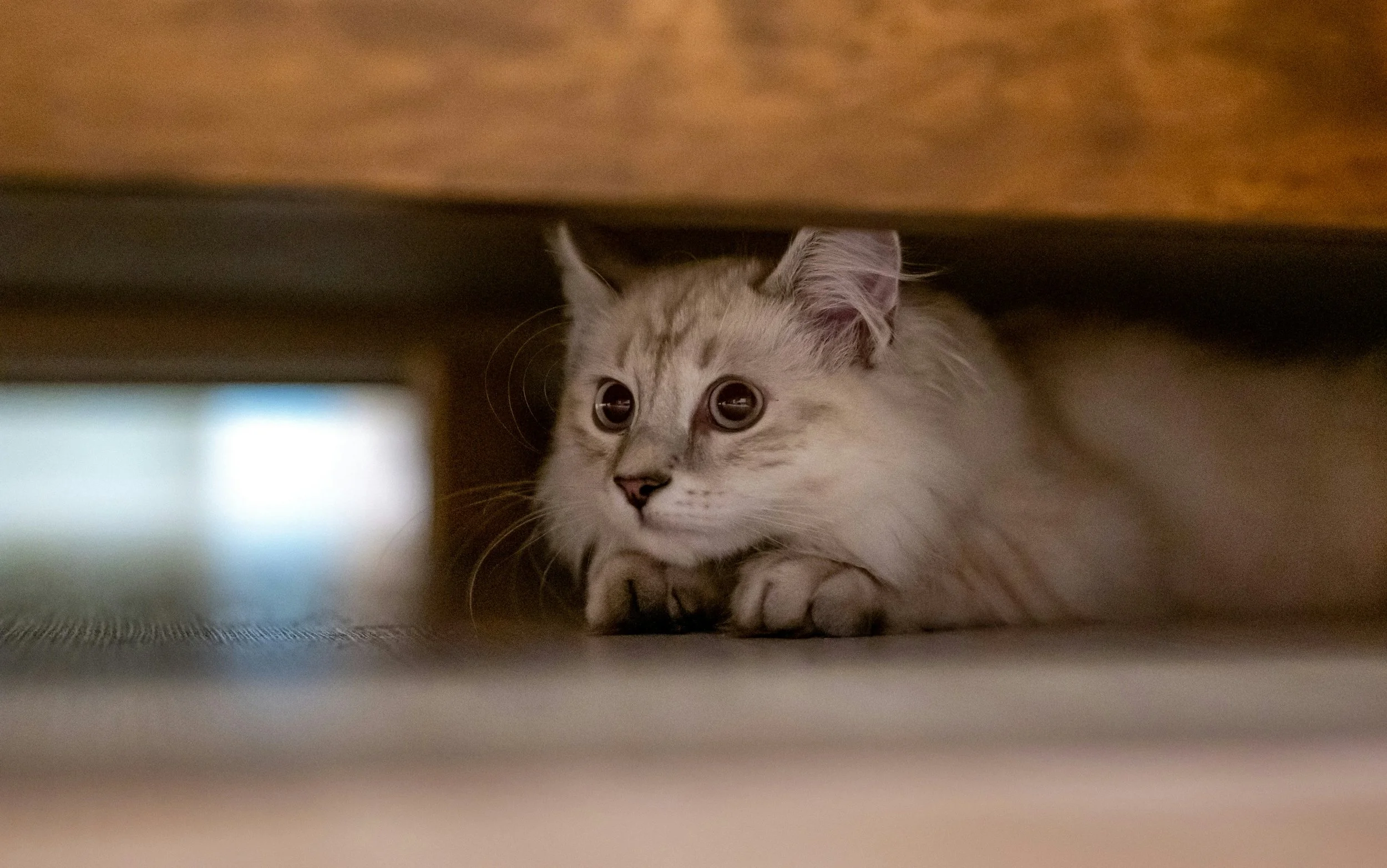
Does your cat bolt for the closet the second a thunderstorm rolls in? Does she flatten herself under the bed for hours after the neighbors set off fireworks, or bristle at a garbage truck backing up outside? Most cats aren't thrilled by loud, sudden noise, but for a real subset of them, the reaction goes well past dislike. It becomes fear and anxiety severe enough to affect behavior and health. Veterinarians call this noise aversion, and it's a recognized medical condition, not a personality quirk.
The sounds that set it off tend to share a few traits: they're loud, they come from nowhere in particular, and they don't follow a pattern a cat can predict, think fireworks, thunder, construction equipment, or a slamming door. Nobody knows exactly why some cats react this strongly and others barely blink. It may be an existing anxiety tendency that loud sound intensifies, a past traumatic experience, or something picked up from another anxious animal in the house. What matters more than the "why" is recognizing that it's real, that it's treatable, and that your veterinarian is the right person to help you sort it out.
Signs your cat may be noise averse
Cats are quieter about distress than dogs, which can make noise aversion easy to miss or write off as "she's just shy." Watch for:
Hiding for extended periods, well after the noise has stopped
Trembling or crouching low with ears flattened
Excessive panting or drooling
Avoiding the litter box, or eliminating outside it
Trying to bolt or squeeze into tight, hard-to-reach spaces
Persistent yowling, whining, or unusual vocalization during the noise
Refusing food or treats she'd normally take
Uncharacteristic swatting, hissing, or aggression when approached
Overgrooming or other stress-displacement behaviors
Cats who already show separation anxiety or unusual wariness around strangers may be more predisposed, according to the American Animal Hospital Association (AAHA), which lists similar signs across species.
The don'ts
Don't scold her for the fallout. If your cat knocks something off a shelf mid-panic or claws at a door trying to escape, resist the urge to correct her in the moment. When destructive behavior is tied to genuine fear, punishment doesn't teach a lesson, it just teaches her that loud noises are followed by you being upset too. That's one more thing to dread.
Don't force the exposure. Carrying a terrified cat out to "get used to" fireworks, or shutting her out of her hiding spot to prove there's nothing to fear, will not desensitize her. It's far more likely to make the fear worse, and a cornered, panicked cat can injure herself or you trying to get away.
Don't overcorrect in the other direction, either. It's tempting to hover, coo, and fuss over a frightened cat, but heavy attention or your own rising anxiety can reinforce hers. Cats read our body language closely. Your calm presence in the room, without crowding her, tends to help more than active comforting. Let her come to you if and when she wants to.
The dos
Do identify her specific triggers. Not every noise-averse cat reacts to the same sounds. If thunderstorms send her under the bed but the vacuum doesn't faze her, thunder is your trigger to plan around, not noise in general. Knowing this ahead of predictable events (Fourth of July, New Year's Eve, a scheduled construction project next door) lets you set up support before the anxiety hits rather than after.
Do build her a genuine safe space. Most cats already have an instinct to retreat somewhere enclosed when frightened. Give that instinct somewhere good to land: a covered crate, a closet, or a quiet room stocked with a familiar blanket, an item of your clothing, and maybe a favorite toy. Feed her meals or treats there occasionally when things are calm, so the space reads as good news, not exile.
Do offer distraction and positive association. Treats, a food puzzle, or a stuffed toy during a noise event can shift the emotional association over time and give her something to focus on besides the sound itself.
Do talk to your veterinarian about calming aids. Depending on how often and how severely your cat reacts, a vet may suggest:
Synthetic pheromone products (such as Feliway). These are undetectable to people but are designed to lower stress signals in cats.
Compression wraps, which apply steady, gentle pressure similar to swaddling, for a calming effect some cats respond well to.
Nutraceuticals, which are foods, dietary supplements, or isolated nutrients derived from food sources that provide extra health or medical benefits beyond basic nutrition.
Prescription options, on a case-by-case basis. While dogs have an FDA-approved noise aversion treatment, cats don't currently have an equivalent approved product. So, a vet may discuss off-label options for cats with more severe or frequent episodes.
When to call the vet
Any time you notice a new or worsening behavioral change in your cat, it's worth a conversation with your veterinarian, even if you've already started trying some of the steps above at home. Left unaddressed, chronic noise-related anxiety can affect a cat's overall health and quality of life over time, not just her nerves on the Fourth of July.
Credit and sources
This piece is adapted from "Addressing the Fear: Noise Aversion and Your Pet," a Fast Fact Sheet published by American Veterinarian (dvm360), July 2, 2018. All credit for the original framework, the dos-and-don'ts structure, and the core veterinary guidance goes to that publication. This version narrows the focus to cats specifically and adds independent research to verify and expand on the original's claims.
Additional sources consulted:
American Animal Hospital Association, "Noise Aversion in Pets: Causes, Signs, and How to Help"
Vetster, "Noise Aversion in Cats: Causes, Treatment and Associated Conditions"
Beata, C., et al., "Effect of alpha-casozepine (Zylkene) on anxiety in cats," Journal of Veterinary Behavior, 2(2), 40-46 (2007), summarized via Zylkene USA
"Effect of l-theanine tablets in reducing stress-related emotional signs in cats: an open-label field study," Irish Veterinary Journal (2018), full text
"Effects of a synthetic feline facial pheromone analogue (F3, Feliway) on stress and cardiovascular parameters during clinical examination in cats: a prospective crossover study," PMC
"Effectiveness of F3 feline facial pheromone analogue for acute stress reduction within clinical veterinary practice," Veterinary Evidence
U.S. Food and Drug Administration, freedom of information summary for Sileo (NADA 141-456), fda.gov; Zoetis, "Zoetis Announces Launch of SILEO for Treatment of Noise Aversion in Dogs" (2016)